SpinDataCom is aiming to develop a new type of laser that can quickly change the polarization of light. This would allow faster, more efficient data transmission on Earth and in space.
The explosive growth of available information requires a disruptive shift in the development of high-bandwidth and energy-efficient communication technology. At the same time, space-communication is critical with the acceleration of human activities in space. Laser-based space-light communication is attracting great interest due to the increasing demand for inter-satellite and ground-to-satellite communication. However, as the light intensity diminishes over long-distance, the development of a new light-coding method is crucial for reliable high-speed information transmission.
Will future bandwidth requirements for earth and space communications be met by conventional lasers, while keeping the overall power consumption manageable?
Copyright IJL
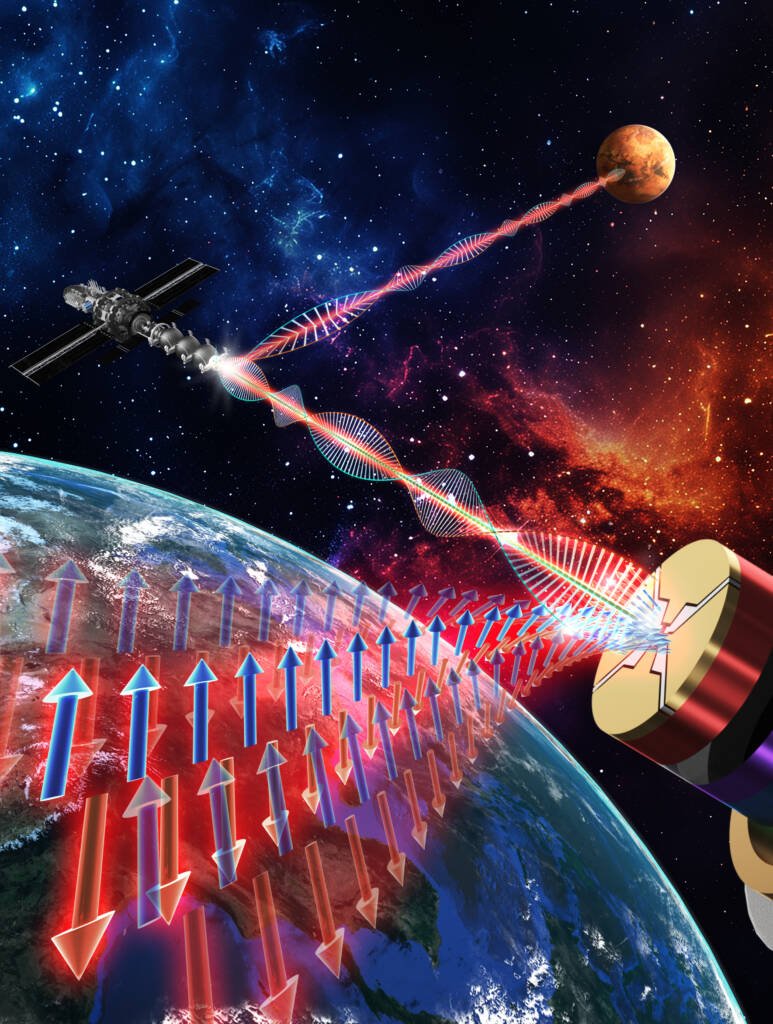
SpinDataCom will overcome these limitations and revolutionize space and earth communications combining the advances in spintronics and semiconductor lasers with injected unequal number of spin up/down electrons. The electron spin imbalance in spin-lasers is transferred to the circular polarization of light which enables ultrafast polarization modulation, low-power consumption and highly-efficient information coding, implemented even on a single photon. Our approach can be transferred to existing fiberoptic networks, exceeding conventional transmitters in data rates and power efficiency.
Gathering experts from 4 EU countries, SpinDataCom will build a disruptive proof-of-concept (TRL4) for spin-lasers, enabling ultrafast modulation via full electrical spin and magnetization control, to enable groundbreaking technologies for space and Earth data communication. This ambitious approach has potentially transformative impacts on society, economy, and environment due to its many applications on Earth and for space.
With our Industrial Advisory Board, a strong communication, dissemination and exploitation plan, global visibility on SpinDataCom’s results will be ensured while enabling the transfer towards commercialization.
Project objectives
Build disruptive devices with electrical spin injection and polarization control for space and Earth data communication.
Expected impacts
Technology
Spin-V(E)CSELs technology could greatly improve the technology development in the fields of space exploration, Galileo services, advances semi-conductor spintronics, quantum computing, AI and Secure communication.
Space-light communication with spin-V(E)CSELs will become the fastest, the most energy-efficient and the most secure communication way between Earth and Mars (or other planets). This technology could greatly improve GPS accuracy by adding features allowing indoor positioning. It will contribute towards EU’s strategic autonomy by enabling the deployment of the next generation of chips. Spin-VCSEL can be used in quantum computing and communication and accelerate the EU quantum technology development (Quantum Flagship). Spin-VCSEL can be used for increasing computing diversity and speed, benefiting AI applications. Finally, Spin-VCSELs can be used for Li-Fi application for secure information exchanges, adapting to airplane, hospital, and conference center circumstances.
Environment
Spin-V(E)CSELs technology could greatly improve the ENVIRONMENTAL IMPACT in the fields of space exploration, Galileo services AND DATA CENTERS.
Faster and less energy-consuming Spin-V(E)SELs technologies will accelerate space exploration, therefore the exploitation of spatial valuable minerals and resources. The increasing data-communication speed by using spin-V(E)CSELs will effectively reduce the number of satellites needed for intra-space communication, and reduce Earth’s loss of resources and energy. Our spin-lasers use up to 10 times less power than current lasers. The use of this technology in data centers will greatly reduce power consumption and reduce cooling requirements.
Society
Spin-V(E)CSELs technology could greatly improve the societal impact in the fields of space exploration, Galileo services, data centers and Secure communication.
This breakthrough technology will establish a robust foundation for the future prospect of human immigration to Mars. People will get better GPS service and data communication for real-time environmental monitoring and high-resolution space imaging. People will also benefit better service like remote medical visit, positioned in remote environments. Spin-V(E)CSEL technology will support the explosive growth of information communication demand. Through novel Li-Fi application, people can benefit from faster and more secure communication.
Economy
Spin-V(E)CSELs technology could greatly improve the ECONOMY in the fields of space exploration, Galileo services, advances semi-conductor spintronics, quantum computing, AI and Secure communication.
SpinDataCom expects to increase the economic output and job positions in the Mission to Mars. SpinDataCom expects to increase the economic output of the global market for Earth observation data and services. Spin-V(E)CSEL technology contribute to the growing semiconductor market with the rise of smart devices and cars. SpinDataCom will accelerate the building of optical quantum computers. Reservoir computing based on spin-VCSELs will significantly improve the processing speed and expand the reservoir computing market. Spin-VCSELs based on polarization encoding technology will have great potential to promote the LiFi market by a factor of 2.