
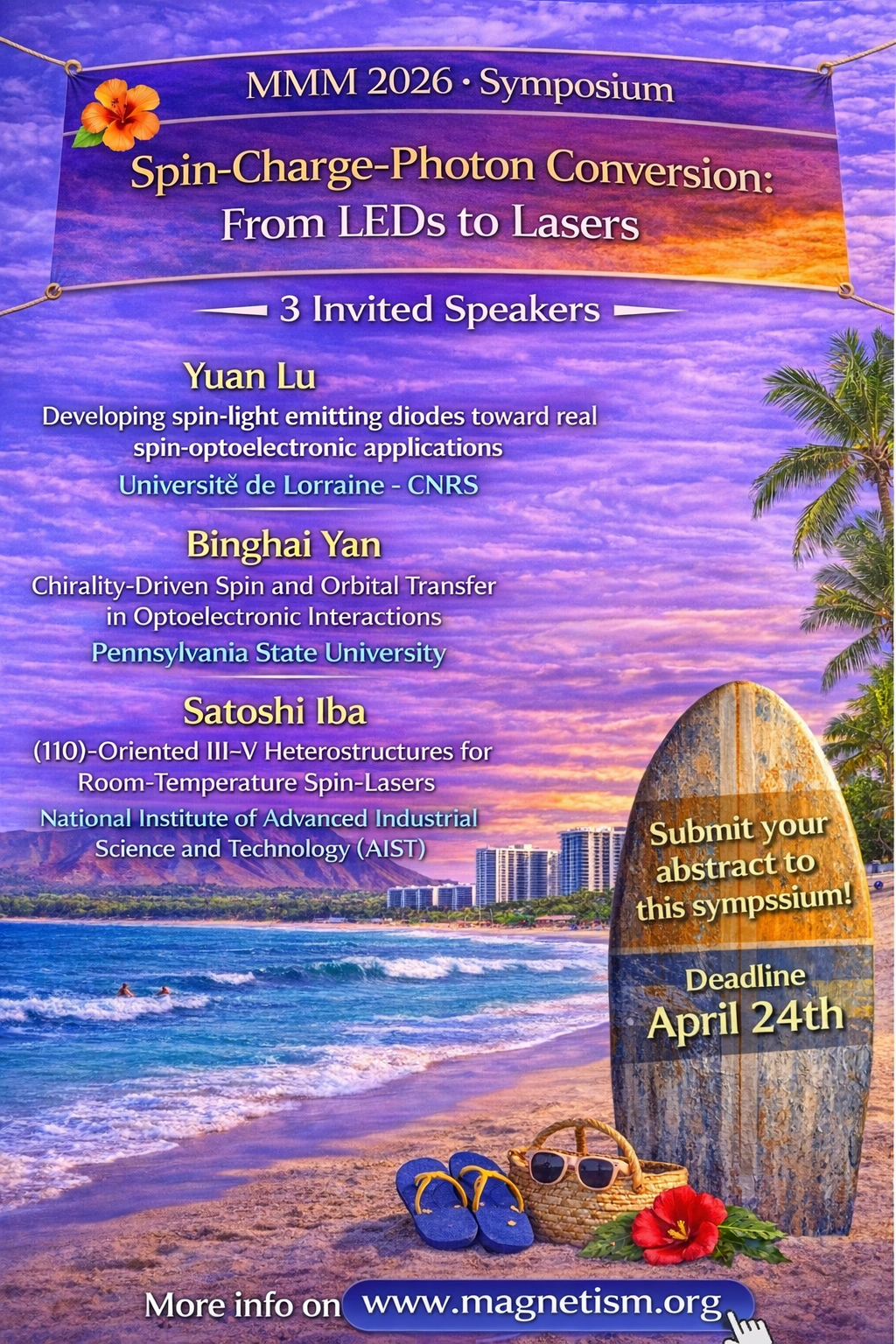
On November 2026, our partner Igor Žutić (UNIRI) will organize a symposium in Hawaii on the topic of Spin-charge-photon conversion: From LEDs to lasers.
While magnetic materials provide a natural platform to store the information and spintronic computer memories are expected to replace existing memories, the transfer of spin-encoded information poses a different set of challenges that will be addressed in this symposium.
Outside of magnetic materials spin typically decays within ns or micron. This limitation can be overcome by taking advantage of the spin-charge-photon conversion. From the conservation of the angular momentum, the recombination of spin-polarized carriers leads to emitted circularly polarized light. The spin information can be transferred to photons and travel much faster and farther. The operation of lasers with such injected spin-polarized carriers is much faster that the best conventional lasers[1].
Remarkably, advances in conventional spintronics and magnetic storage, using CoFeB/MgO junctions for perpendicular anisotropy and spin-orbit torque, also enable efficient spin-charge-photon conversion and reversal of the helicity of the emitted light at 300 K[2] in light-emitted diodes (LEDs). Another advance is generating circularly polarized light from chiral materials, enabling helicity control of the emitted light in LEDs at no external magnetic field[3].
[1]. M. Lindemann et al. Ultrafast spin-lasers, Nature 568, 212 (2019)
[2]. P. A. Dainone et al. Nature 627, 783 (2024)
[3]. F. Furlan et al. Electrical control of photon spin angular momentum in organic electroluminescent materials. Nat. Photon. 19, 1361 (2025)